Our Story
Pomuckar grew gradually, over several years, together with my son Honzík.
I never told myself: “I’m going to build a website for teachers.” I simply wanted to prepare learning aids that my own child would enjoy. And as Honzík grew, the aids grew with him. In the end they turned into a project that today helps other parents, teachers, and children too.
It all started with a songbook

One of the first things I created was a songbook.
I wanted to keep in one place the songs and children’s rhymes we could sing together. I built on my older scouting songbook and prepared my own materials with sheet music, lyrics, and illustrations.
Back then I had no idea that this was the beginning of a project that would stay with me for years to come.
From one aid to the next
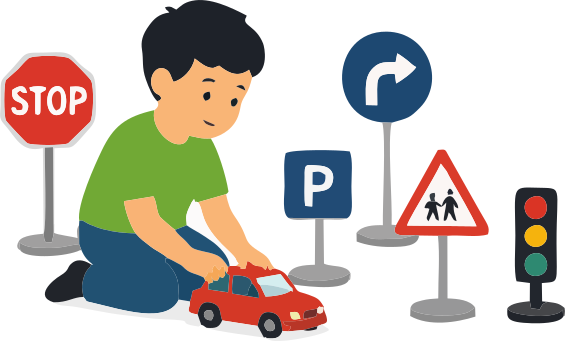
I have experience with vector graphics, so it felt natural to create my own aids that way.
First came road signs and a simple car-and-dice game. Later came handwriting worksheets, materials for preschool, first letters, first counting, and gradually more aids for the first years of primary school.
Every stage of Honzík’s life brought new ideas. And with them, new materials.
Logico Piccolo changed everything
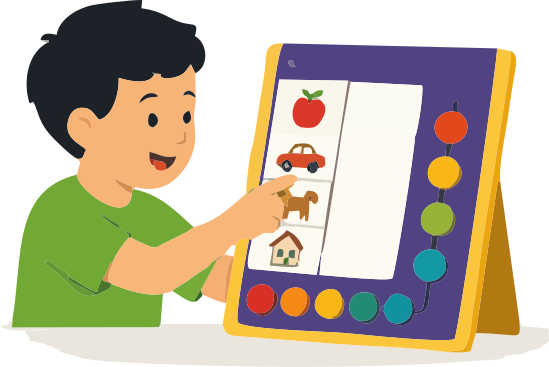
A major turning point for me was the Logico Piccolo board.
Honzík absolutely loved working with it, so I got one for home as well. I started creating my own exercises in CorelDRAW and very quickly ran into a problem.
Making them by hand was slow and full of mistakes. A single typo, a misplaced picture, or a small change meant reworking the whole material. On top of that, the double-sided print layouts had to line up exactly.
So, as a programmer, I wrote my first script that automatically turned the prepared source material into a correctly assembled double-sided PDF. All of it still as clean vector graphics, so the results stayed sharp on every print and never lost quality.
A computer does repetitive work far better than a human ever could.
Once the computer can do one thing…
I started thinking differently.
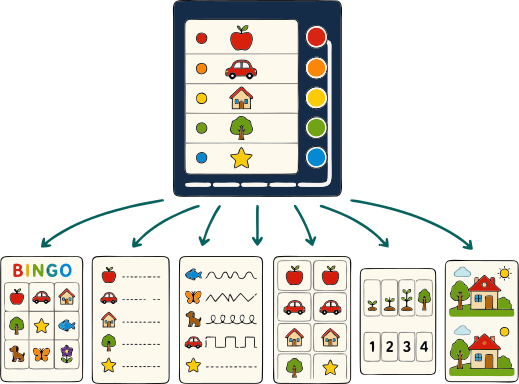
If I have ten pictures, why make just one set of cards out of them?
Why not automatically generate a memory game, bingo, Logico Piccolo, worksheets, handwriting exercises, word searches, or other activities?
Instead of drawing individual materials, I began building generators. Source material prepared once could be reused again and again, each time a little differently.
That gradually became the central idea of the whole project.
I look for inspiration everywhere
To this day I follow many Czech and international sources, educational websites, and teaching channels. I read professional articles, bachelor’s and master’s theses, and I keep an eye on new directions in education.
When an aid catches my attention, I don’t think about how to copy it. I think about what problem it solves and whether it could be made simpler, clearer, or with more variations.
Most materials are made mainly for Honzík, but every now and then I create an aid for lower-secondary, high school, or even university level.
The web as a natural step
The aids kept piling up.
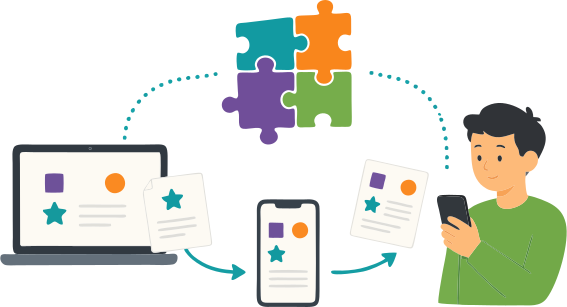
At first I only used them at home. Later I began sharing them with friends and teachers. In the end, the web became a natural distribution channel. A web application was born that lets you create your own variations of the aids directly online and have them available anytime.
I believe in paper

It may sound strange, given that I spend most of my time programming.
And yet I believe above all in paper-based aids.
A tablet or a computer cannot replace working with cards, dice, a pencil, scissors, or building blocks. Digital technology has its place in education, but more as a supplement than as the main means of teaching.
That is why most of Pomuckar focuses on materials meant to be printed.
Alongside them, a few digital projects have appeared too — for example games using QR or barcodes, or simple demonstrations of augmented reality. Technology, in my view, should help learning, not replace it.
How I use artificial intelligence
I design, adjust, and check every material by hand. In fact, a large part of Pomuckar was created long before today’s AI tools arrived.
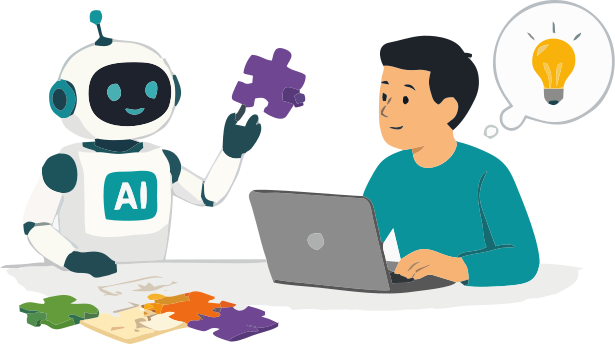
I use artificial intelligence mainly as an assistant for programming, designing algorithms, or finding technical solutions. It helps me think about how to implement things — not about what children should be solving.
We grow together

There is one thing about this project that I still enjoy the most.
Honzík is learning.
And I am learning with him.
Just each of us something a little different.
- When Honzík was learning with the Logico Piccolo board, I was learning to create PDF documents.
- When he searched for hidden pictures held up to the light, I was learning image processing.
- When he looked for words along curved lines, I was discovering the mathematics of Bézier curves.
- When he solved word searches, I was looking for an algorithm that could generate them as well as possible.
And every time he learned something new, I learned something new as well.
So Pomuckar is not just a collection of worksheets.
And that is exactly why the project keeps going. Because Honzík keeps growing. And Pomuckar grows with him.
What’s next?

Pomuckar is not a finished project.
I still have dozens of ideas in my head for new aids, games, and generators. My goal is to spend as much time as possible creating them, and as little as possible on repetitive work.
If Pomuckar helps save time for even a single teacher, or brings joy to even a single child, then all these years of development were worth it.
And if, thanks to it, the next generation of children learns just a little better, that will be the greatest reward of all.